The above equation only works when the expected annual cash flow from the investment is the same from year to year. If the company expects an “uneven cash flow”, then that has to be taken into account. At that point, each year will need to be considered separately and then added up. If you choose this option, you can populatenet cash flows for 10 periods.
Payback Period in Excel
WACC is the calculation of a firm’s cost of capital, where each category of capital, such as equity or bonds, is proportionately weighted. For more detailed cash flow analysis, WACC is usually used in place of discount rate because it is a more accurate measurement of the financial opportunity cost of investments. WACC can be used in place of discount rate for either of the calculations.
Posts from: Excel Cash Flow Formula

Discount rate is useful because it can take future expected payments from different periods and discount everything to a single point in time for comparison purposes. Cash flow is the inflow and outflow of cash or cash-equivalents of a project, an individual, an organization, or other entities. Positive cash flow that occurs during a period, such as revenue or accounts receivable means an increase in liquid assets. On the other hand, negative cash flow such as the payment for expenses, rent, and taxes indicate a decrease in liquid assets. Oftentimes, cash flow is conveyed as a net of the sum total of both positive and negative cash flows during a period, as is done for the calculator.
Discounted Payback Period Calculation Analysis
The discounted payback period determines the payback period using the time value of money. This inserts the first entry for the cumulative cash flow calculation. Depending on the number of cash flow input boxes you selected, you need to enter all cash flows. For example, for your investment, enter $500, $600, $700, $800, and $900. Or the numbers suddenly start fluctuating downwards from year 3 on?
Payback Period Formula
The payback period can be defined as the amount of time required to repay the primary investment by using the cash inflows it generates. The value indicates the exact time charitable contributions 2020 it will take to recover initial costs, and helps to evaluate the risks of the project. The payback period is the time it will take for a business to recoup an investment.
- Finally, we can determine the total payback period by adding the negative cash flow years and fractional period.
- This target may be different for different projects because higher risk corresponds with higher return thus longer payback period being acceptable for profitable projects.
- We’ll derive the cumulative cash flow from the given information, then calculate the Payback Period from this cash flow.
- For example, a series of payments of $2000, $5000, $3000, and $2500 over 4 different years can be defined as uneven cash flows.
- Use Excel’s present value formula to calculate the present value of cash flows.
The discounted payback period is often used to better account for some of the shortcomings, such as using the present value of future cash flows. For this reason, the simple payback period may be favorable, while the discounted payback period might indicate an unfavorable investment. People and corporations mainly invest their money to get paid back, which is why the payback period is so important. In essence, the shorter the payback an investment has, the more attractive it becomes. Determining the payback period is useful for anyone and can be done by dividing the initial investment by the average cash flows.
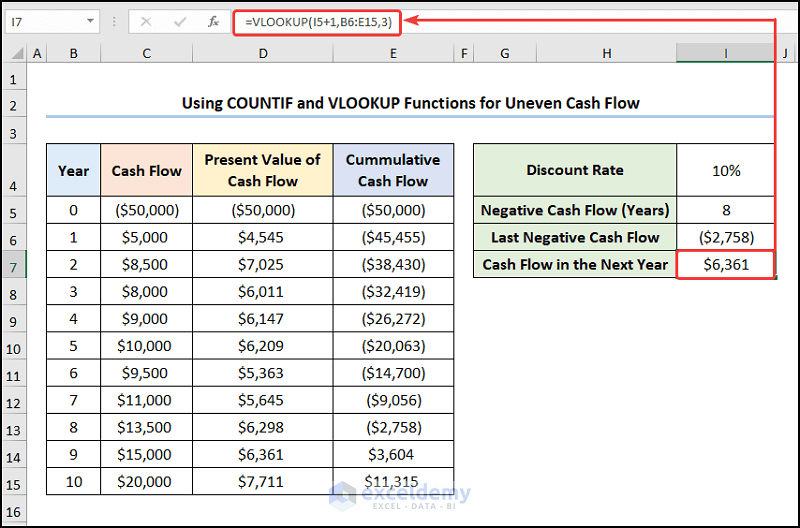
Thus, the project is deemed illiquid and the probability of there being comparatively more profitable projects with quicker recoveries of the initial outflow is far greater. Cumulative net cash flow is the sum of inflows to date, minus the initial outflow. Next, we’ll find the cash flow for the next year by using the VLOOKUP function again.
We obtain the break-even point of a project when the net cash flows exceed the initial investment. The breakeven point is the price or value that an investment or project must rise to cover the initial costs or outlay. The payback period refers to how long it takes to reach that breakeven.
The appropriate timeframe for an investment will vary depending on the type of project or investment and the expectations of those undertaking it. This period does not account for what happens after payback occurs. Many managers and investors thus prefer to use NPV as a tool for making investment decisions.
The payback period for this project is 3.375 years which is longer than the maximum desired payback period of the management (3 years). If the forecast assumes or is simplified ina way that cash flows remain constant over the time horizon of the projection, theradio button “even cash flow” shall be selected. The calculator shows only oneinput field – the even, constant cash flow for all periods within the forecast. A higher payback period means it will take longer for a company to cover its initial investment. All else being equal, it’s usually better for a company to have a lower payback period as this typically represents a less risky investment.